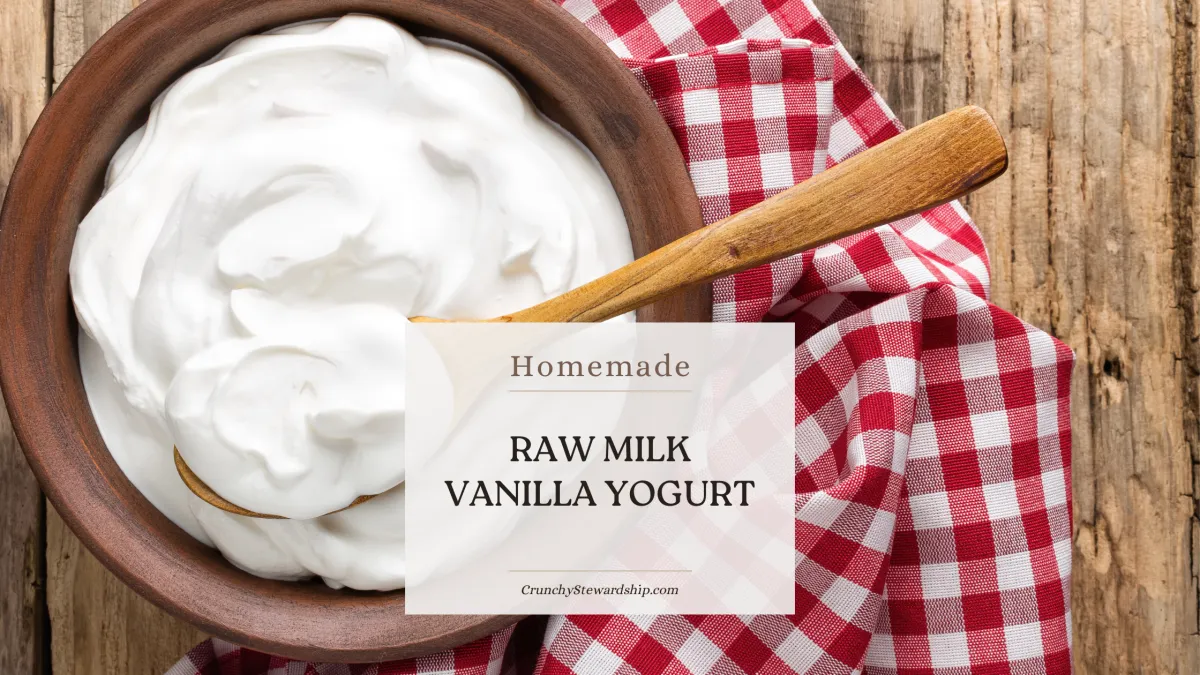
Simple Raw Milk Vanilla Yogurt
🥛 Raw-Milk Vanilla Yogurt (Low-Heat Method)
Making your own yogurt is a great way to save money and feed your family something nutritious without worrying what ingredients are in your food. Yogurts are notorious for having artificial flavors, preservatives, and sugar in them. Making a raw milk vanilla yogurt is a great next step in your crunchy stewardship journey!

What to Expect When Making Raw Milk Yogurt
Since you are avoiding the 180°F "scald" step to preserve the raw benefits, your yogurt will behave differently than store-bought or pasteurized homemade yogurt:
Thinner Consistency: Because you aren't denaturing the proteins with high heat (180°F), raw milk yogurt is naturally much thinner—often more like a drinkable yogurt or kefir consistency than a thick Greek yogurt.
Bacterial Competition: In pasteurized yogurt, the milk is a "blank slate." In raw yogurt, your starter culture (the bacteria you add) has to compete with the native bacteria already living in the milk. Occasionally, this can lead to a batch that doesn't set quite right or has a slightly different tang, but it is generally successful if your starter is strong.
Tips on Finding Quality Ingredients
Making yogurt only requires a few ingredients. One of those ingredients is actually yogurt. It sounds strange to use yogurt to make yogurt, but yogurt itself is simply fermented milk with certain strands of bacteria in it. In order to make more yogurt, you simply need to let those bacteria grow in some fresh milk.
Starter Yogurt
The yogurt you use needs to have live cultures in it. You can go to your local grocery store and pick up any unflavored yogurts as long as it has live cultures. Only a small amount is needed so you can pick out one of the small single serving containers. Once you make your first batch, you will be able to use your own yogurt for future batches.
Look For:
Live Cultures - check packaging for names such as Streptococcus thermophilus and Lactobacillus bulgaricus. Yogurts that don't have live cultures are basically just thickened sweet milk with very minimal nutritional benefits and they will not work in creating more yogurt at home.
Plain Yogurt - no sweeteners or flavors. They disrupt the fermentation process. They can be added in after your milk has fermented though!
Good Quality - organic and grass fed is the best and will have the highest nutritional content.
Raw Milk
I use raw milk for our yogurt. This is not necessary - in fact you can use any milk you prefer. If you aren't going to use raw milk, I would at least recommend using an organic whole milk. This will keep your yogurt a bit creamier. In all truth though, you can use whatever milk is in your fridge.
Most yogurt recipes you will find out there actually tell you to heat up milk past the pasteurization temperature in the fermentation process (more on this below).
I choose not to pasteurize the milk and keep temperatures around 110°F in order to preserve more of the good, natural bacteria in it. The one thing to note about making yogurt at lower temperatures is that the yogurt does not thicken quite as much as you may be used to.
That being said, if you prefer to have a thicker yogurt (similar to store bought) then you may prefer to heat the milk up to a higher temperature. For this recipe though, we will preserve the raw milk. It comes down to what you prefer most - health benefits or texture.
Where to Find Quality Ingredients
We get our yogurt and our milk from a local Amish farm. We know they are high quality products. This is definitely not necessary, but could be something you may want to consider! You will be able to find the yogurt for your starter at your local grocery or health food store.
If you are new to raw milk and need to find a supplier check out these resources.
First check your state's raw milk laws
Find local milk suppliers on this map or by asking around
The Temperature Thresholds for Raw Milk Yogurt
A quick lesson on pasteurization before getting to the recipe.
To keep your milk truly "raw" in terms of biological activity, here is what happens at different temperatures:
100°F - 110°F (Safe Zone): This is the "Goldilocks" zone. It is warm enough to wake up the thermophilic bacteria (the kind in yogurt starters) so they can ferment the milk, but it is cool enough that the native raw milk bacteria and enzymes remain intact.
118°F (Enzyme Threshold): According to Weston A. Price Foundation (WAPF) guidelines and general food science, natural food enzymes (like phosphatase) begin to degrade and become inactive around 118°F.
145°F (Pasteurization Zone): This is the temperature used for "vat pasteurization" or large batches. Held for 30 minutes. This is where significant bacterial die-off occurs.
161°F (High-Temp Short-Term): If you are pasteurizing milk at home this is the method generally recommend. It is a higher temp held for 15 seconds then quickly cooling it.
180°F (Traditional Yogurt Scald): Most conventional yogurt recipes tell you to heat milk to 180°F. This is done to denature the whey proteins (making them unravel), which creates a thick, firm yogurt. However, this temperature kills everything—good and bad bacteria alike—and destroys the enzymes. Again - if you prefer a nice thick yogurt you may prefer this method.
280°F (Ultra-Pasteurization): You have likely seen this phrase on milk or other dairy products. This is the temperature used for ultra-pasteurized milk.
Materials Needed
Insta Pot or Large Pot
Thermometer
Whisk
Quart Mason Jar or other glass container
I prefer making my yogurt in an Instant Pot because it is very easy to keep the yogurt at a specific temperature, but making it on the stove with a large pot is simple as well. You can use whatever you have available, but a thermometer will be necessary if you are making it on the stove. The key is to keep the temperatures below 110°F to preserve natural bacteria.
🔵Instant Pot Settings You’ll Use
Most Instant Pots have two yogurt modes:
“Yogurt—Normal”: around 105–110°F → good for RAW yogurt
“Yogurt—Boil”: heats to 180°F → will pasteurize the milk. It does result in a thicker yogurt though.
🥛 Raw Milk Vanilla Yogurt Recipe
Ingredients
3 1/2 Cups Raw Milk
1/4 Cup Live Culture Yogurt
Added Later
1–2 tsp Vanilla Extract
1-3 tbsp Honey or Maple Syrup (optional)
Instructions
1. Warm the raw milk (WITHOUT pasteurizing it)
🔵Instant Pot
Pour raw milk into the Instant Pot’s stainless insert.
Press Yogurt → Adjust → “Normal”
Let it warm for 10–20 minutes, or check until milk is between 100–110°F
🟣Stove Top
Pour your raw milk into the pot.
Turn the burner on the lowest possible setting.
Stir gently and constantly. Because the burner is hotter than the milk, you need to stir to ensure the milk at the bottom doesn't accidentally spike past 118°F and kill the enzymes.
Check the temperature frequently.
As soon as it hits 110°F, turn the burner off and remove the pot from the heat immediately.
2. Stir in the yogurt starter
🔵Instant Pot
Don't turn the Instant Pot off but remove the lid
Remove a ladles worth of warm milk and stir the yogurt starter in to it.
Pour the warm milk & yogurt mixture into the Instant Pot
Wisk thoroughly
🟣Stove Top
Remove a ladles worth of warm milk and stir the yogurt starter in to it.
Pour the warm milk & yogurt mixture into the pot
Wisk thoroughly
3. Ferment
🔵Instant Pot
Put the lid back on the Instant Pot (vent can be open or closed)
Let it continue to sit for 8 to 12 hours
🟣Stove Top
Since you can't leave the burner on, you must trap the heat you just created.
Put the lid on the pot.
Put the pot into the oven with the light turned on
Let it sit undisturbed for 24 hours.
4. Flavor
🔵Instant Pot
After fermentation, remove the insert.
Stir in vanilla extract
Sweeten if desired (honey or maple syrup)
🟣Stove Top
After fermentation remove pot from the oven
Stir in vanilla extract
Sweeten if desired (honey or maple syrup)
5. Chill
Put the yogurt in the jar or container you plan to keep it in.
Refrigerate for at least 6 hours.
Raw-milk yogurt thickens a bit once cold, but remember it likely will be more liquidly than what you are traditionally used to.
And that's it! You have made your first batch of raw milk vanilla yogurt. How did it go?
Let me know what questions you have as you make your very first batch!